I live deeply. I feel deeply, think deeply, and search deeply. I do not believe in coincidence. I believe in “as above, so below”—that what lives deep within us is also reflected in our outer lives. Our unconscious is often behind the wheel, quietly shaping the way we live. This is why I believe that healing needs to take place at this deeper level if we are to break old patterns and create meaningful change in our everyday lives.
People fascinate me. I have a deep interest in the human condition—in what shapes us, the wounds we carry, what drives us, and what ultimately helps us to grow and heal. As Rumi wrote, “The wound is the place where the Light enters you.” I believe that our wounds do not only carry stories of pain; they can also become gateways through which light, insight, and transformation enter our lives.
Over the years, my personal journey has taken many turns and led me into different fields of study, each time guided by the same underlying longing: to understand the human condition more deeply, so that I can walk alongside others with compassion and without judgement.
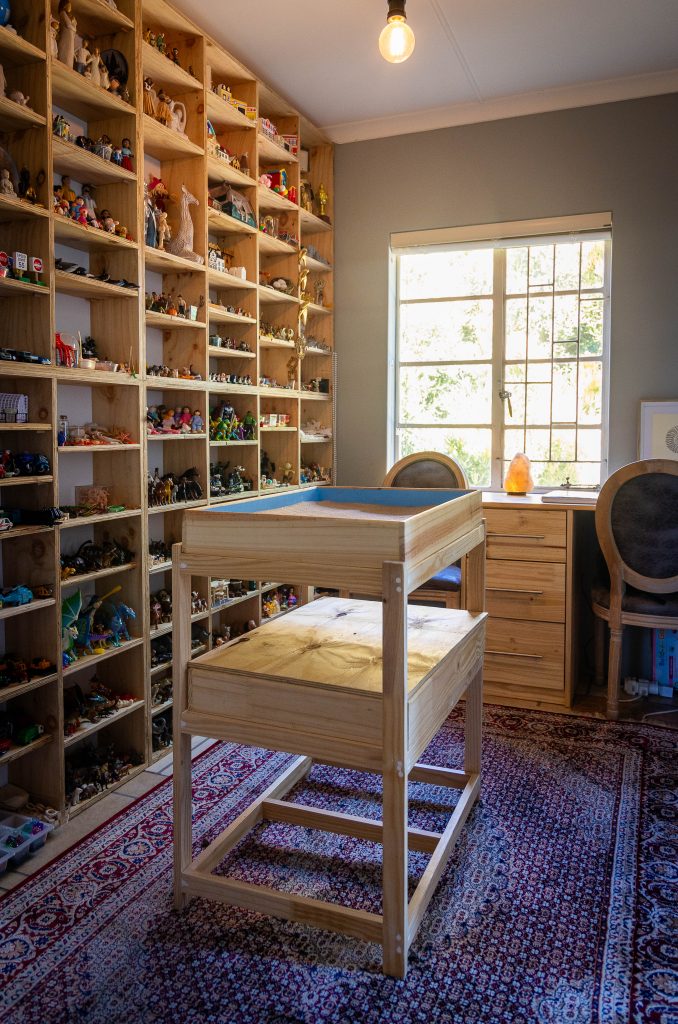
The unique journeys of my four children have invited me to look more deeply at life, death, trauma, and my own journey on this earth. They are my inspiration, my mirrors, and my teachers. Through them, Sandplay found its way into my adult life, allowing me to offer the little girl within me a safe space to play again, to dream, to heal, and simply to be.
My own experiences in the sand have transformed my life on a profound level—so much so that I began studying Sandplay in order to offer this deeply healing experience to other children and adults.
The healing process that unfolds in the sand fascinates me. It awakened in me a deep desire to better understand the human psyche’s inherent capacity for self-healing—particularly when it is given the freedom to unfold within a safe, protected, and non-judgemental space.
For me, Sandplay is more than a therapeutic method; it has become part of the way I live. It awakens my creativity, helps me to slow down and reconnect, gives me hope, and continually teaches me to listen more deeply to the quiet wisdom within.
“Mantelboog” is not an established Afrikaans word. It does not appear as a recognised entry in the major Afrikaans dictionaries and therefore has no official definition or interpretation.
In symbolic language, however, this is what the name means to me:
A mantle suggests an inner layer of protection or a hidden potential that has not yet fully come to light. It may also represent the royal or sacred dimension of the Self—a sign that the psyche is discovering a deeper identity.
In Jungian symbolism, an arch represents a transition: a gateway between the known and the unknown, and a psychological movement from one state of consciousness to another. It is an image of passage, protection, and transformation.
Seen together, Mantelboog can therefore symbolise a protected passage into a deeper experience of the Self—a threshold through which hidden aspects of the personality can gradually emerge into consciousness.
A wonderfully creative friend and I worked together on the name and logo. It is unapologetically Afrikaans, because that is what my heart tells me: return to your roots. Your community. Your people.
This is where healing begins.
The logo found its inspiration in the lyrics of “Kyk hoe glinster die maan” by Laurika Rauch. The song carries a quiet sense of wisdom and wonder that, for me, beautifully reflects what we wanted to express.
On the surface, “Kyk hoe glinster die maan” is a beautiful song about a child who believes in Father Christmas and then moves through the different stages of life. At first, the narrator believes in the magic of Father Christmas. Later comes the disappointment of discovering that he is not real. She then dreams of true love and eventually becomes a parent herself, watching her own children believe in that same enchantment.
But symbolically, the song reaches much deeper.
It is about both the loss and rediscovery of wonder. The recurring questions express a longing for the enchantment, innocence, and imagination of childhood. Yet the song does not end in disillusionment. Instead, it suggests that enchantment simply changes form as we grow older. The child’s dream of Father Christmas becomes the adult’s dream of love, connection, family, and a place where we belong.
From a Jungian perspective, the moon is an especially rich symbol. It is often associated with the feminine, the unconscious, intuition, dreams, and the deeper layers of the psyche. The refrain evokes a journey into the world of imagination, hope, and the soul.
Through every stage of life, the moon remains the same—quietly and faithfully illuminating the world of dreams, even as reality continues to change.